Press & Media
Press & media resources.
For interviews, review copies, or media questions, reach us at hello@righttherepublic.com or through the contact form. Descriptions, bio, images, and interview topics are below and free to use in coverage of the book.
The book at a glance
- Title
- Right the Republic
- Subtitle
- Eleven Constitutional Amendments to Break America’s Political Gridlock and Restore Trust in Government
- Author
- Pat LaPointe
- Category
- Nonfiction — Politics & Government / Civic Affairs
- Formats
- Hardcover, paperback, and ebook (audiobook coming soon)
- Length
- Approximately 300 pages
- Publisher
- Independently published
- Publication
- January 2027
- ISBN
- Pending
- Price
- To be announced
- Availability
- Amazon (preorder link to come)
Book descriptions
Logline
Eleven constitutional amendments to break America’s political gridlock and restore trust in government.
Short (~50 words)
In Right the Republic, entrepreneur and “systems-thinker” Pat LaPointe lays out eleven practical constitutional amendments designed to repair how American democracy functions. The book brings a nonpartisan lens to diagnosing why our institutions are failing and offers specific, structural fixes meant to be debated, improved, and acted on.
Long (~200 words)
American democracy is struggling to survive. The greatest threats are not the things we argue about, but the erosion of the structures that enable us to argue constructively. In Right the Republic, entrepreneur, investor, and “systems-thinker” Pat LaPointe argues that the problem isn’t the people in government; it’s the incentives, structures, and rules that shape how they behave. Drawing on a career spent diagnosing why complex organizations succeed or fail, he finds the root causes of the problems and proposes eleven clear constitutional amendments to repair it.
The fixes are structural in nature and resolutely nonpartisan and work equally well regardless of which party is in power. They range from ethics, elections, and a more deliberative Senate to executive accountability, congressional effectiveness, an independent judiciary, and use of military force. There is also a proposed Amendments by the People that gives citizens a workable path to amend the Constitution directly while preserving the need for broad consensus.
LaPointe doesn’t claim to have all the answers; he offers a unique view and innovative plan meant to be argued with and improved. Right the Republic is an attempt to hand the country better tools — and an invitation to use them.
About the author
Short (~60 words)
Pat LaPointe is a successful entrepreneur and investor and the author of Right the Republic. Over three decades he founded or co-founded three companies in data and analytics, backed more than a hundred early-stage startups, and served on numerous for-profit and nonprofit boards. He lives and works in Montana, and recently founded Constitution Labs — a civic education nonprofit.
Long (~160 words)
Pat LaPointe has spent more than three decades learning why some organizational systems thrive while others fall apart. An entrepreneur and investor, he founded or co-founded three successful companies in data and analytics, and has backed more than a hundred early-stage startups as an investor. He chairs Frontier Angels, Montana’s angel investor network; co-founded and led Early Stage Montana; and serves on the board of Lighthouse Ranch, which works on teen mental health and suicide prevention. Years ago he wrote his first problem-solving book, Marketing by the Dashboard Light, where the focus was on a very tricky data/people problem — measuring the financial impact of marketing. That book found a wide audience in boardrooms and university classrooms and helped revolutionize the way marketing was evaluated. In Right the Republic, his first book on American democracy, he turns a systems-builder’s eye on the federal government. He lives and works in Montana, and recently founded Constitution Labs — a civic education nonprofit.
Cover & author images
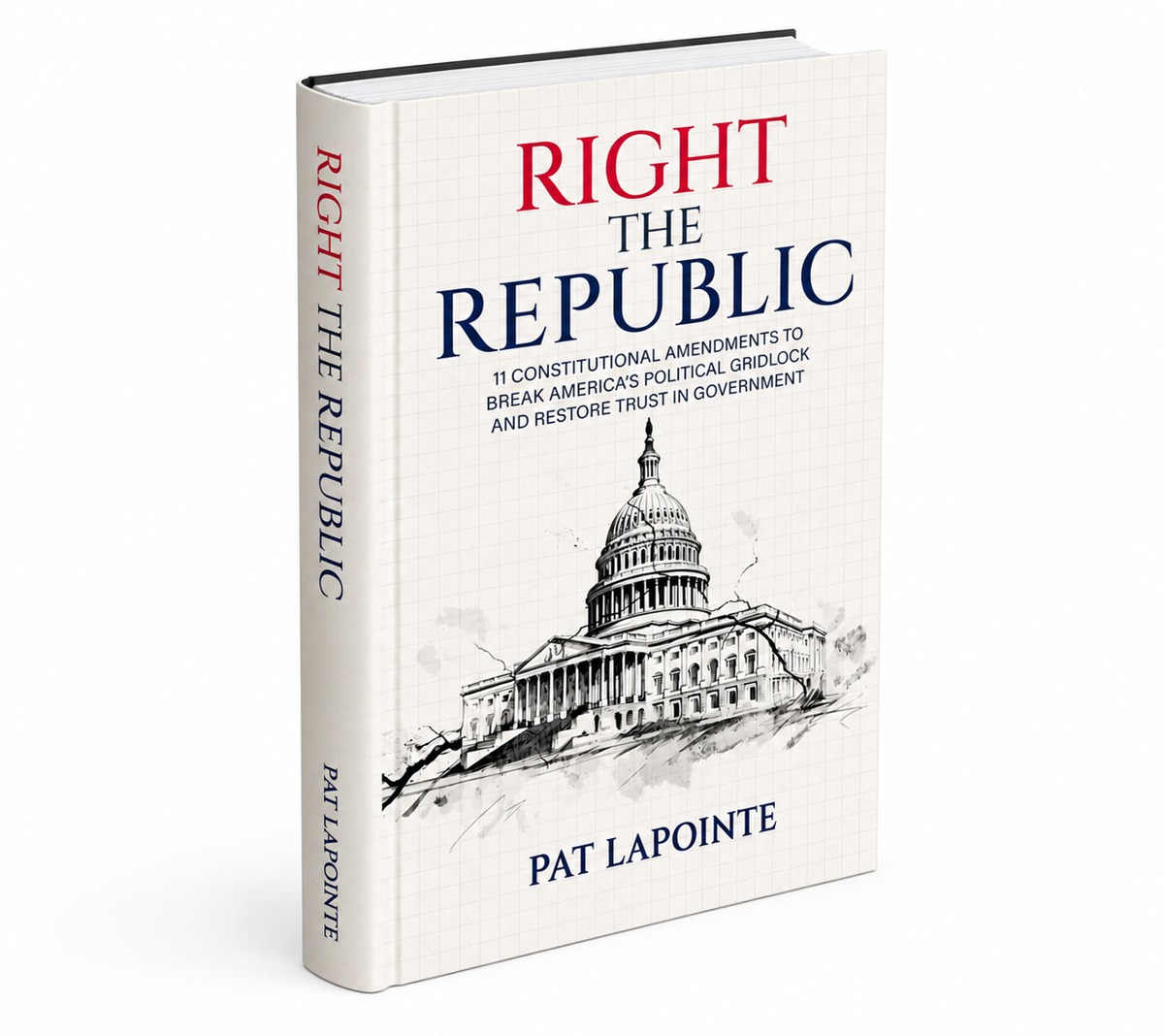

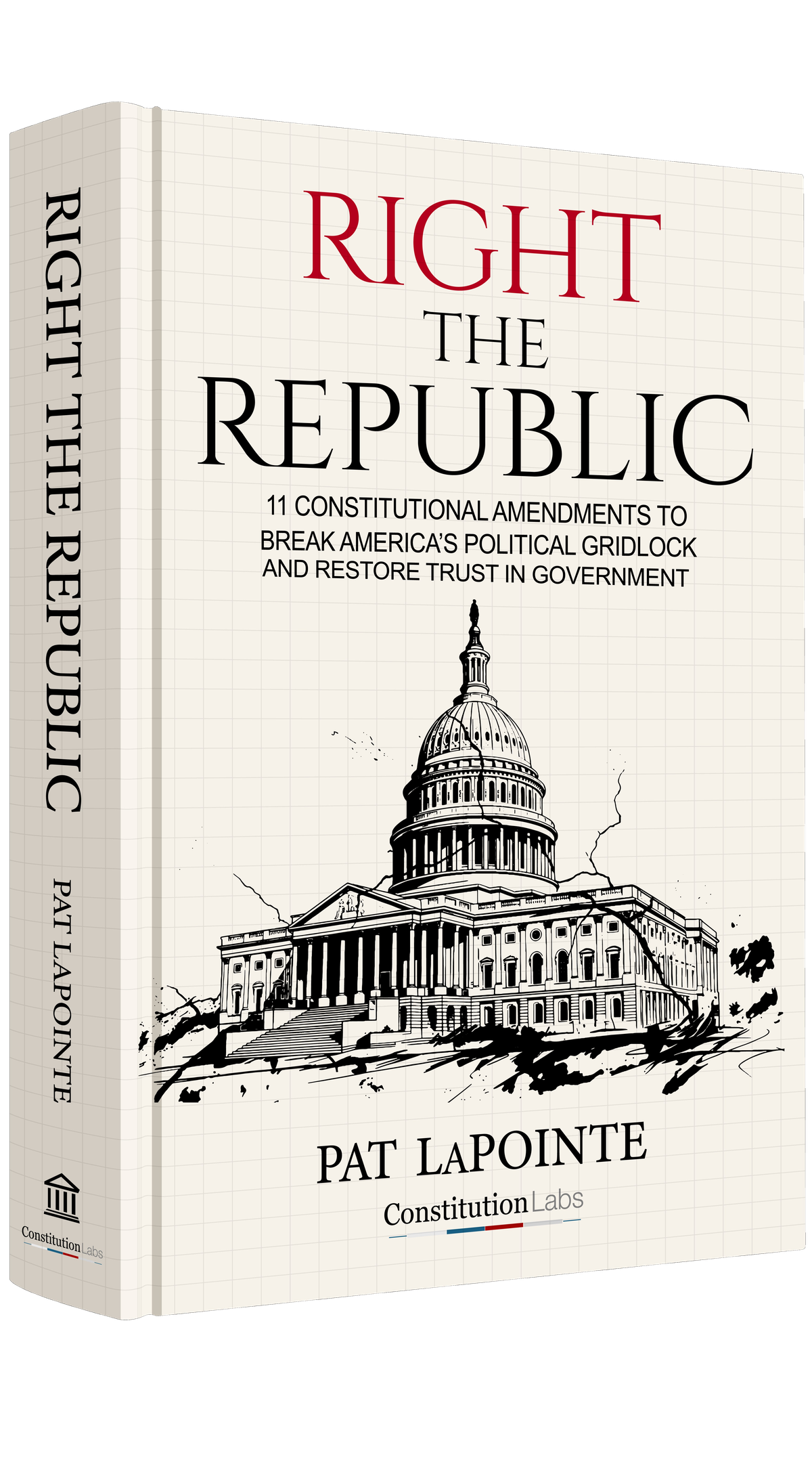
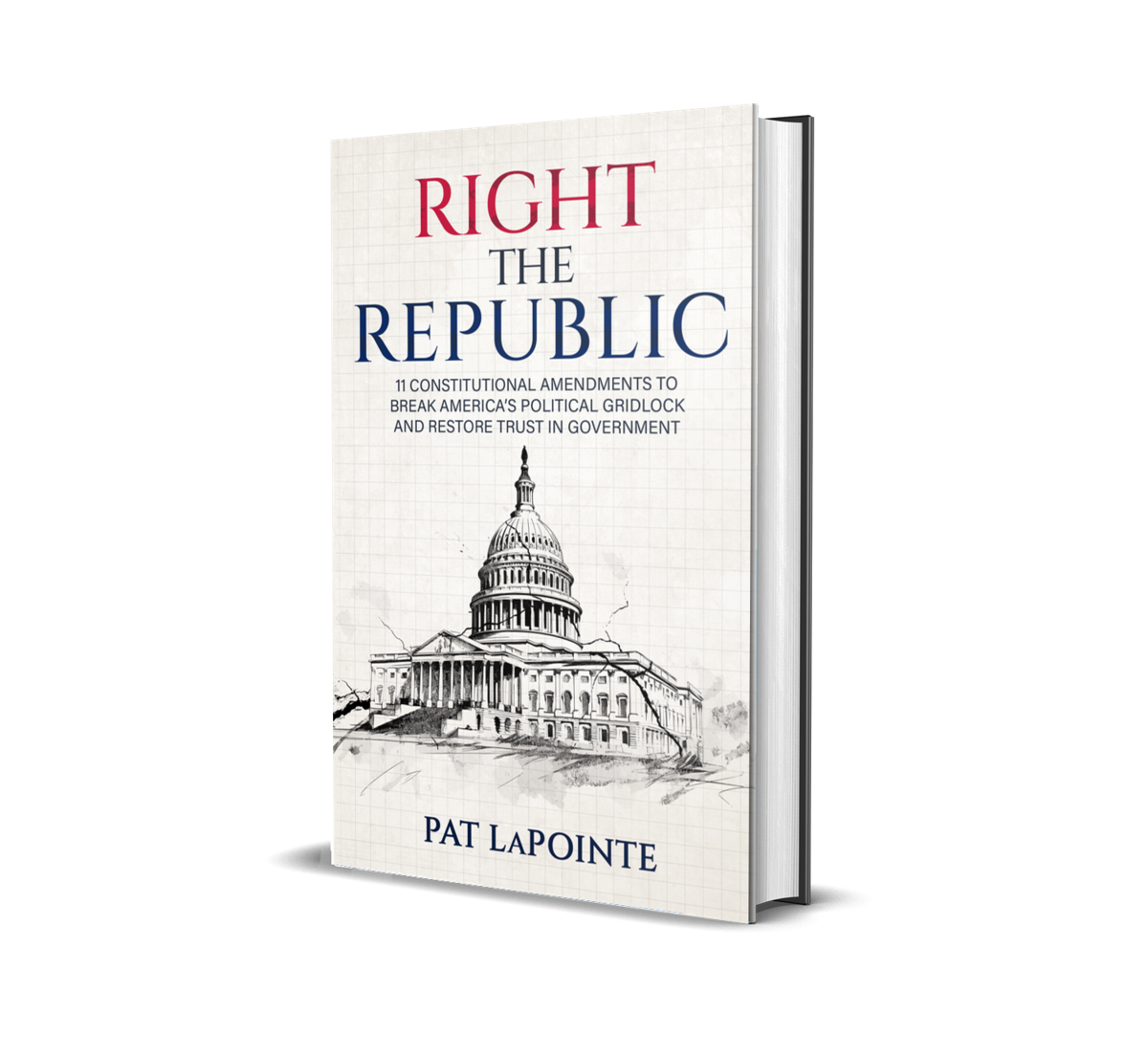
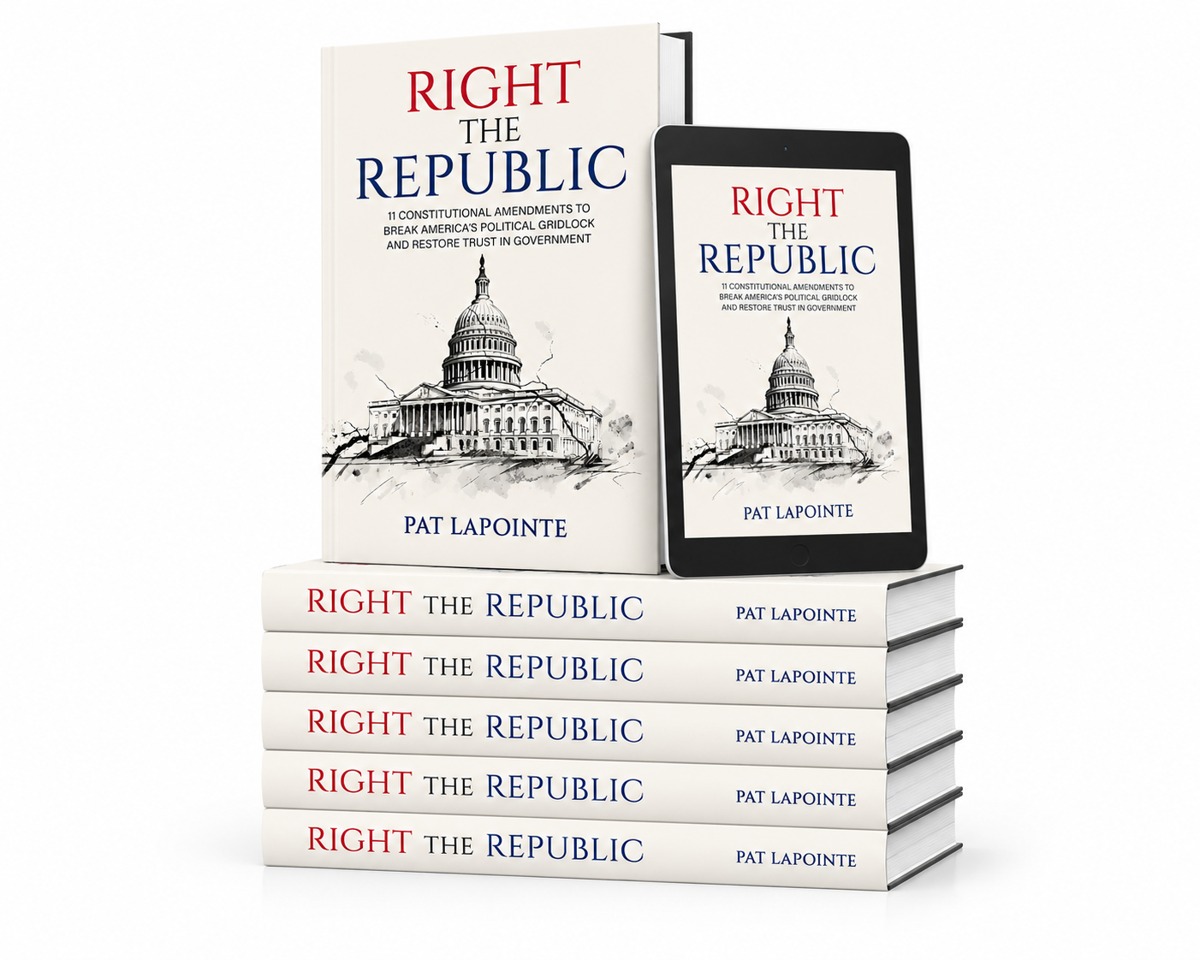

Cover and author images may be reproduced in coverage of the book and author, with credit. Higher-resolution or alternate files available on request.
Interviews & topics
Pat LaPointe is available for interviews, podcasts, and speaking engagements.
Topics he can speak to
- Why America’s dysfunction is structural, not partisan — and why “how we fight” matters more than “what we fight about.”
- How institutions are buckling under stresses they were never designed for — 240 years of human nature finding and exploiting the cracks.
- Article V: why the Constitution’s own repair mechanism is effectively broken, and the “Amendments by the People” keystone fix.
- What a systems-and-incentives lens from business and investing reveals about government failure.
- The eleven specific amendments — money in elections, a deliberative Senate, executive accountability, an independent judiciary, the rights of future generations.
- Why the project names no villains and takes no side.
- What an ordinary citizen can actually do to restore their trust in government.
- Why a non-politician, non-scholar wrote this.
Suggested questions
- You’re an investor and entrepreneur, not a politician or constitutional scholar. What made you write this?
- You argue the problem isn’t the people in office but the systems around them. What do you mean?
- Amending the Constitution is famously hard. Why — and what’s your “Amendments by the People” idea?
- How can constitutional reform be nonpartisan when it usually splits along party lines?
- Which of the eleven amendments do you expect to be most controversial?
- If you could pass only one amendment, which — and why?
- Critics will call structural reform naive or impossible. What’s your answer?
- What can a reader do the moment they put the book down?
Touchstones — quotes for citation
A few historical touchstones behind the book’s argument, offered for media use.
“A republic, if you can keep it.”
— Benjamin Franklin, 1787 (as recorded by James McHenry)“If men were angels, no government would be necessary.”
— James Madison, Federalist No. 51, 1788“It ought to be hard, but not that hard.”
— Justice Antonin Scalia, on amending the Constitution, 2014“Posterity! You will never know how much it cost the present Generation to preserve your Freedom! I hope you will make a good use of it.”
— John Adams, letter to Abigail Adams, 1777“Remember, democracy never lasts long. It soon wastes, exhausts, and murders itself. There never was a democracy yet that did not commit suicide.”
— John Adams, letter to John Taylor, 1814“The great privilege of the Americans does not consist solely in their being more enlightened than other nations, but in their being able to repair the faults they may commit.”
— Alexis de Tocqueville, Democracy in America, 1835“A body of men holding themselves accountable to nobody ought not to be trusted by anybody.”
— Thomas Paine, Rights of Man, 1791“The Constitution supposes what the history of all governments demonstrates, that the executive is the branch of power most interested in war and most prone to it. It has accordingly with studied care vested the question of war in the legislature.”
— James Madison, letter to Thomas Jefferson, 1798“Plans are worthless, but planning is everything.”
— Dwight D. Eisenhower, 1957“The dogmas of the quiet past are inadequate to the stormy present. The occasion is piled high with difficulty, and we must rise with the occasion.”
— Abraham Lincoln, 1862“Government of the people, by the people, for the people.”
— Abraham Lincoln, Gettysburg Address, 1863“The main source of national power and national greatness is found in the average citizenship of the nation.”
— Theodore Roosevelt, 1910“Hope is not the conviction that something will turn out well, but the certainty that something is worth doing no matter how it turns out.”
— Václav Havel, 1986Read an excerpt
A reading sample of the book is available to read on the site.
Advance praise
Advance praise will be posted here as it arrives. Reviewers and media: request a review copy and we’ll get one to you.